
Your buyers have changed how they look for companies. They are not only typing into Google anymore. They are asking AI.
They open a chat tool and ask which companies solve a problem, which vendors are good in an industry, and what a particular business actually does. And the AI answers. It names some companies and leaves out others.
So here is the question worth sitting with. When someone asks AI about what you do, does your company come up? And if it does, is it described the way you would want?
Most marketers do not know the answer. Not because they are behind, but because nothing in their usual reporting was built to tell them. Your analytics show you Google traffic and direct visits. They do not show you whether an AI read your site, understood it, and decided you were worth mentioning.
What changed, in plain terms
For years, getting found meant ranking on a search results page. Someone searched, scrolled a list of links, and clicked. Your job was to earn a spot on that list.
AI search works differently. There is often no list. The buyer asks a question and gets an answer, which is built from what the AI can find and trust across the web. You are either part of that answer, or you are not. There is no page two to land on.
That is a real shift in how visibility works. It is not the end of traditional SEO. Plenty of people still use Google. But a growing share of your buyers are starting somewhere new, and that share is not going back.
Why some sites get picked, and others get skipped
AI tools are not magic. They read websites much like a very fast, very literal visitor. A few things make that easier or harder.
Can the AI actually read your site? Some websites load their content in ways that are hard for automated readers to see. If the substance of your page is not plain in the underlying code, an AI may simply miss it.
Is it clear what you do? AI rewards clarity. A site that states plainly who it helps and what it offers is easy to summarize. A site heavy on vague taglines and light on substance is easy to skip.
Can the AI find its way around? Most sites publish a sitemap, a behind-the-scenes map of their pages. There is also a newer, optional file called llms.txt, a plain-language summary written specifically for AI crawlers. Few companies have one yet. Having one is a small, quiet advantage.
None of this requires you to become a technical expert. It just requires knowing where your site stands today.
It All Starts with Clarity
This is how we work at Clear Brand Strategy, and it applies here as much as anywhere. You look before you build. You find out what is actually true before anyone spends money fixing the wrong thing.
You would not redesign a website on a hunch. You should not chase AI visibility on one either. The smart first move is not a project. It is a clear, honest look at how AI sees your site right now.
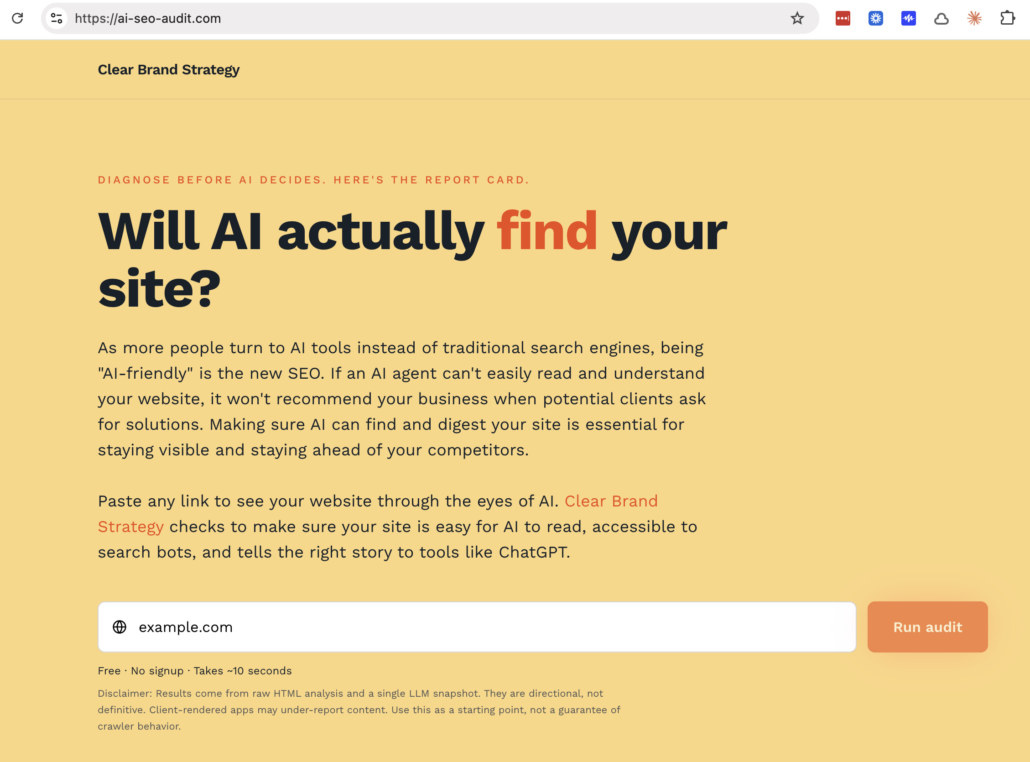
So we built a free tool that does exactly that — ai-seo-audit.com. You paste in your URL and, in about ten seconds, you see how AI search engines read your site, whether they can find you, and how they would describe you to someone asking. No signup, no jargon, no pressure to fix anything.
Run yours. If the result raises questions, that is what we are here for. The score is the easy part. Knowing what to do with it is where a partner helps.
Common questions about AI search
Does AI search replace traditional SEO?
No. It sits alongside it. Plenty of buyers still use Google, and ranking there still matters. But a growing share now starts with AI, so the smart approach is to be visible in both places rather than betting everything on one.
How is an AI search different from a Google search?
A Google search gives you a list of links to choose from. AI search often gives you a single answer, built from sources the AI trusts. You are either part of that answer, or you are not. There is no second page to land on.
Do I need an llms.txt file?
It is optional, not required. An llms.txt file is a plain-language summary of your site written for AI crawlers. Few companies have one, so adding it is a small, quiet advantage rather than a must-have. It is worth doing once your bigger visibility questions are answered.
How do I know if AI can find my company?
You check. Our free AI audit shows you how AI search engines read your site, whether they can find you, and how they would describe you, in about ten seconds. It is the fastest way to go from guessing to knowing.